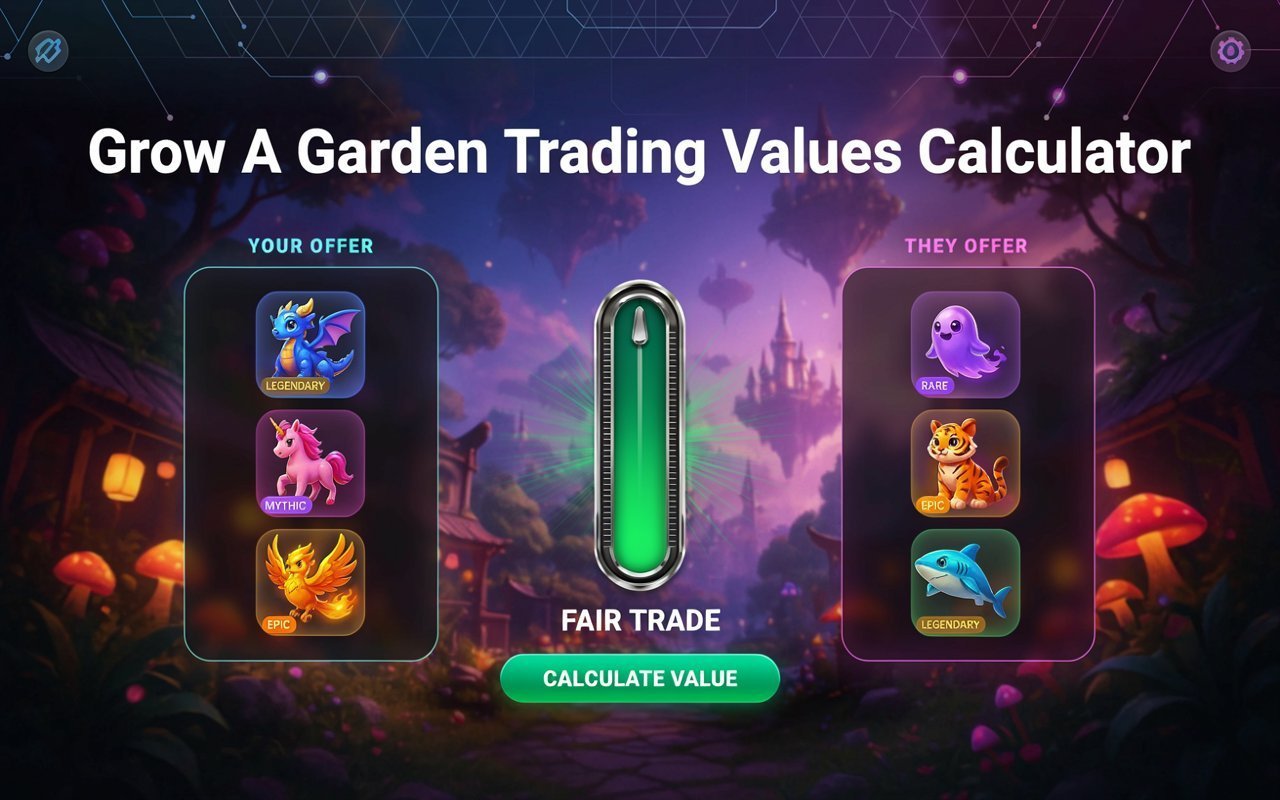
Grow a Garden Trading Values Calculator: Check Pet & Item Trade Values (2026)
Complete guide to the Grow a Garden Trading Values Calculator — check pet values, verify fair trades, understand rarity tiers, mutations, and demand-driven pricing for 2026.
Every trade in Grow a Garden is a math problem. You are comparing the value on your side against the value on their side. When you know both numbers, you know whether a trade is a win, a fair deal, or a loss. When you guess, you gamble — and the other player usually knows the math better than you do.
The Grow a Garden Trading Values Calculator eliminates guessing entirely. You select your pets and items, configure their rarity, weight, and mutations, then compare them against whatever the other player is offering. The calculator tells you the estimated value of each side and flags the trade as Win, Fair, or Loss before you ever click accept.
This guide walks you through everything: how the calculator works, how Grow a Garden trading operates under the hood, what makes a pet valuable, complete value tier lists, mutation multipliers, safe trading practices, and the mistakes that cost players thousands of Sheckles every day. This page focuses specifically on pet trading — for crop, fruit, and plant values too, see our Trading Value Calculator.
What Is the Trading Values Calculator?
The Trading Values Calculator is a tool built specifically for Grow a Garden players who want to verify whether a trade is fair before they commit to it. It pulls from a regularly updated database of pet values, mutation multipliers, and demand modifiers to give you a numerical comparison of both sides of any trade.
Why It Exists
Grow a Garden has no built-in value display for pets. When another player offers you a Legendary Hydra for your Rainbow Butterfly, the game does not tell you which side is getting the better deal. You are expected to simply know — or guess.
Most players guess wrong. The trading economy in Grow a Garden moves fast. Values shift with every update, event, and new pet release. A pet that was worth 500,000 Sheckles last month might be worth 200,000 today because a new Divine-tier pet dropped and pulled demand away from it. Without a calculator that tracks these shifts, you are trading blind.
The Trading Values Calculator fixes this by giving you a single number for each side of a trade. If Side A is worth 320,000 and Side B is worth 310,000, that is a Fair trade. If Side A is worth 320,000 and Side B is worth 150,000, that is a Loss — walk away.
What the Calculator Tracks
The calculator factors in every variable that affects trade value:
- Base rarity value — the starting value floor for each rarity tier
- Pet species — some pets within the same rarity tier are worth more due to demand
- Mutations — Golden, Rainbow, Shiny, and unique mutations like Chakra or Foxfire
- Mutation level — higher mutation levels multiply value further
- Weight — heavier pets are rarer and worth more
- Current demand — community-driven demand shifts based on updates and events
- Multi-pet trades — add multiple pets and items to each side for complex trades
How to Use the Trading Values Calculator
Using the calculator is straightforward. The entire process takes about 30 seconds once you know what both players are offering.
Step 1: Select Your Pet or Item
Open the Trade Checker and start with Side A — your side of the trade. Search for the pet or item you are offering. The calculator has a searchable database of every tradeable pet, egg, and item in Grow a Garden.
Step 2: Choose the Rarity Tier
Once you select a pet, choose its rarity. This is critical because the same species can exist at different rarity levels depending on how it was obtained. A Rare Butterfly and a Mythical Butterfly are fundamentally different assets. Make sure you match the exact rarity shown in your inventory.
Step 3: Add Mutations
If the pet has a mutation, select it from the mutation dropdown. This is where most value miscalculations happen — players forget to account for mutations or underestimate how much they multiply base value.
Set the mutation level as well. A level 1 Golden mutation adds value, but a level 50 Golden mutation adds significantly more. The calculator adjusts the multiplier based on the exact mutation level you enter.
Step 4: Set Weight (If Known)
Pet weight affects value more than most traders realize. Check our Pet Weight Calculator for details on how weight ranges work. If you know the pet's weight, enter it. If you do not know it, the calculator uses the median weight for that species, which gives you a reasonable estimate.
Step 5: Configure Side B
Repeat the same process for everything the other player is offering. You can add multiple pets and items to Side B — the calculator sums them all and compares the total against Side A.
Step 6: Read the Verdict
The calculator displays the estimated value of both sides and flags the trade:
| Verdict | What It Means | Action |
|---|---|---|
| Win | Your side is worth less than what you are receiving | Accept — you profit |
| Fair | Both sides are within 10% of each other | Accept if you want the pet; the trade is balanced |
| Loss | Your side is worth more than what you are receiving | Decline — you lose value |
A trade within 5% of equal is considered perfectly Fair. Between 5% and 15% is Slight Win or Slight Loss. Beyond 15% is a clear Win or Loss. Our full methodology is explained in the How to Never Lose a Trade guide.
How Trading Works in Grow a Garden
Before diving deeper into values, you need to understand the trading infrastructure. Grow a Garden uses a specific system that determines how, where, and when you can trade.
The Farmers Market and Trading Plaza
All player-to-player trading happens at the Farmers Market, sometimes called the Trading Plaza. This is a dedicated zone within the game where players can set up booths, browse other players' offerings, and initiate direct trades.
The Farmers Market is not just a free-for-all chat room. It has structured systems:
- Booth Listings — Players can set up a booth and list specific pets or items they want to trade. Other players browse booths and send trade offers. This is the safest way to trade because both sides can see exactly what is being offered before confirming.
- Direct Trade Requests — You can send a direct trade request to any player in the Farmers Market. This opens a trade window where both players place their items. Both sides must confirm before the trade executes.
- Trade Tokens — Some high-value trades require Trade Tokens to execute. These tokens are earned through gameplay (completing quests, harvesting certain crops, participating in events) and act as a transaction fee. The token requirement prevents rapid-fire trading that could be exploited for market manipulation.
Trade Confirmation and Safety
Every trade requires double confirmation. You place your items, the other player places theirs, and both sides must click confirm. If either player modifies their offer after the initial placement, the confirmation resets — both sides must re-confirm. This prevents the classic "swap scam" where a trader quickly switches a valuable pet for a worthless one right before you confirm.
The game also maintains a Trade History log. You can review your past trades, see exactly what was exchanged, and use this to track patterns if you suspect a trader is operating dishonestly.
What Determines Trading Values
Pet values in Grow a Garden are not set by the game developers. There is no official price list. Values emerge from the intersection of rarity, demand, mutations, weight, and market dynamics. Understanding all five factors is the difference between trading profitably and losing Sheckles.
Factor 1: Pet Rarity Tier
Rarity establishes the value floor. A pet cannot be worth less than what its rarity tier suggests (barring extreme negative demand, which is rare). The current rarity tiers in Grow a Garden are:
| Rarity | Color | Value Floor (Sheckles) | Availability |
|---|---|---|---|
| Common | White | 100 - 500 | Extremely easy to obtain |
| Uncommon | Green | 500 - 2,000 | Easy to obtain |
| Rare | Blue | 2,000 - 10,000 | Moderate effort |
| Legendary | Gold | 10,000 - 50,000 | Significant effort |
| Mythical | Purple | 50,000 - 200,000 | Hard to obtain |
| Divine | Red | 200,000 - 800,000 | Very hard to obtain |
| Prismatic | Rainbow | 800,000 - 5,000,000+ | Extremely rare |
| Transcendent | Iridescent | 5,000,000+ | Rarest tier in the game |
Note: these value ranges are approximate and shift with updates. The Pet Values Guide maintains the latest ranges. Transcendent-tier pets are so rare that their value is essentially determined by whatever the buyer is willing to pay — there is no established market price because so few exist.
Factor 2: Pet Demand
Rarity sets the floor, but demand sets the actual price. Two Mythical-tier pets can have wildly different values because one is in high demand and the other is not.
Demand is driven by:
- Abilities — Pets with strong farming abilities (faster crop growth, better harvest yields, passive Sheckle generation) are always in demand because they provide ongoing economic value.
- Aesthetics — Some pets are simply popular because they look good. The community decides what is "cool," and cool pets trade higher than their stats might suggest.
- Recency — Newly released pets almost always spike in value because everyone wants them. This spike usually settles within 2 to 4 weeks as supply increases.
- Event exclusivity — Pets that can only be obtained during limited-time events maintain high demand long after the event ends, because supply is permanently capped.
- Meta shifts — When game updates change farming mechanics, pets with abilities that synergize with the new meta see demand increases.
Demand is the hardest factor to track manually. This is exactly why the Trading Values Calculator exists — it incorporates demand data from community trading activity so you do not have to guess.
Factor 3: Pet Mutations
Mutations are the single biggest value multiplier in Grow a Garden trading. A base Legendary pet might be worth 30,000 Sheckles. That same pet with a Rainbow mutation at level 50 can be worth 750,000 Sheckles or more. Mutations do not just add value — they multiply it.
The primary mutation types and their approximate multipliers:
| Mutation | Multiplier Range | Notes |
|---|---|---|
| Golden | 2× to 8× | Most common mutation. Still valuable, especially at high levels |
| Rainbow | 5× to 20× | Significantly rarer than Golden. High demand across all tiers |
| Shiny | 8× to 25× | Very rare. Distinctive visual effect makes these highly sought |
| Chakra | 15× to 40× | Unique to specific pets (notably Kitsune). Extreme value |
| Foxfire | 15× to 40× | Kitsune-exclusive. Comparable to Chakra in value |
| Corrupted | 10× to 30× | Gives pets a dark/inverted appearance. High collector demand |
Mutation level matters significantly. The multiplier scales with level — a level 1 Golden mutation might give a 2× multiplier while a level 50 Golden mutation gives 8×. The relationship is not perfectly linear; there are breakpoints where the multiplier jumps. Levels 10, 25, and 50 are the most notable breakpoints.
For a deep dive into how mutations work, see the Complete Pets Guide.
Factor 4: Pet Weight
Weight is the hidden value factor that separates experienced traders from beginners. Every pet has a weight range — when hatched, the pet is assigned a random weight within that range. Heavier pets are statistically rarer (the distribution skews toward the lower end of the range) and are worth more.
A pet at the top 1% of its weight range can be worth 1.5× to 3× more than the same pet at median weight. This is why the Pet Weight Calculator exists — it tells you where a specific weight falls within the distribution for that species so you can accurately assess the premium.
Weight does not affect gameplay mechanics. A heavier pet does not farm better or have stronger abilities. The value premium is purely driven by collector demand — players want the "biggest" version of each pet, similar to how real-world collectors value size in certain collectibles.
Factor 5: Game Updates and Seasonal Events
The developers regularly release updates that introduce new pets, new mechanics, and balance changes. Each update reshuffles the value hierarchy. A pet that was the highest-demand Divine two months ago might drop to mid-tier when a new Divine with better abilities releases.
Seasonal events create temporary value spikes for event-exclusive items and permanent premiums for pets that can no longer be obtained once the event ends. Smart traders buy event pets during the event (when supply is highest and prices are lowest) and hold them until after the event ends (when supply is fixed and prices climb).
Pet Values Tier List: Notable Pets and Their Trading Values
This tier list covers the most notable tradeable pets in Grow a Garden as of August 2026. Values change — always verify with the Trade Checker before making a trade.
Extreme Value Tier
These are the most valuable pets in the game. Trades involving these pets require careful calculation because the margin for error is enormous.
| Pet | Rarity | Key Mutations | Estimated Value (Sheckles) |
|---|---|---|---|
| Kitsune (Chakra) | Prismatic | Chakra | 4,000,000 - 8,000,000 |
| Kitsune (Foxfire) | Prismatic | Foxfire | 3,500,000 - 7,500,000 |
| Corrupted Kitsune | Prismatic | Corrupted | 3,000,000 - 6,000,000 |
| Transcendent Dragon | Transcendent | Any | 5,000,000 - 10,000,000+ |
| Prismatic Phoenix | Prismatic | Rainbow | 2,500,000 - 5,000,000 |
The Kitsune dominates the Extreme tier because it has access to exclusive mutations (Chakra and Foxfire) that no other pet can roll. Combined with its Prismatic rarity, this creates a perfect storm of scarcity and demand. A max-weight Kitsune with a level 50 Chakra mutation is arguably the single most valuable tradeable asset in Grow a Garden.
Very High Value Tier
| Pet | Rarity | Key Mutations | Estimated Value (Sheckles) |
|---|---|---|---|
| Fire Wisp | Prismatic | Golden / Rainbow | 1,500,000 - 3,500,000 |
| Hydra | Divine | Rainbow / Shiny | 800,000 - 2,000,000 |
| Storm Serpent | Divine | Golden / Rainbow | 700,000 - 1,800,000 |
| Celestial Owl | Divine | Shiny | 600,000 - 1,500,000 |
| Crystal Golem | Prismatic | Golden | 1,000,000 - 2,500,000 |
High Value Tier
| Pet | Rarity | Key Mutations | Estimated Value (Sheckles) |
|---|---|---|---|
| Thunder Raptor | Mythical | Rainbow | 300,000 - 700,000 |
| Frost Wolf | Mythical | Shiny | 250,000 - 600,000 |
| Magma Bear | Mythical | Golden | 200,000 - 500,000 |
| Void Cat | Divine | Base (no mutation) | 200,000 - 400,000 |
| Lunar Moth | Mythical | Rainbow | 200,000 - 450,000 |
Mid Value Tier
| Pet | Rarity | Key Mutations | Estimated Value (Sheckles) |
|---|---|---|---|
| Stone Beetle | Legendary | Rainbow | 80,000 - 200,000 |
| Garden Snake | Legendary | Shiny | 60,000 - 150,000 |
| Harvest Mouse | Legendary | Golden | 40,000 - 100,000 |
| River Frog | Rare | Rainbow | 15,000 - 40,000 |
| Sun Bunny | Legendary | Base | 10,000 - 30,000 |
Low Value Tier
| Pet | Rarity | Estimated Value (Sheckles) |
|---|---|---|
| Common Butterfly | Common | 100 - 300 |
| Garden Snail | Common | 100 - 250 |
| Basic Frog | Uncommon | 500 - 1,500 |
| Field Mouse | Uncommon | 500 - 1,200 |
| Brown Beetle | Rare (base) | 2,000 - 5,000 |
Low-tier pets are generally not worth trading individually. However, bundles of low-tier pets can sometimes be offered as part of larger trades to make up value differences. The calculator handles multi-pet trades on both sides, so you can accurately assess whether a bundle of ten Common pets equals one Legendary.
How Mutations Multiply Pet Base Value
Understanding mutation math is essential for accurate trading. The multiplier is not a flat number — it depends on the mutation type, mutation level, and the pet's base rarity.
The Mutation Value Formula
The general formula the calculator uses:
Trade Value = Base Rarity Value x Species Demand Modifier x Mutation Multiplier x Weight Modifier
Each component:
- Base Rarity Value: The floor value from the rarity tier table above
- Species Demand Modifier: A value between 0.5 and 3.0 based on current community demand (1.0 = average demand)
- Mutation Multiplier: Based on mutation type and level (see table below)
- Weight Modifier: A value between 0.8 and 3.0 based on where the pet falls in its weight distribution
Mutation Level Breakpoints
| Mutation Level | Golden Multiplier | Rainbow Multiplier | Shiny Multiplier |
|---|---|---|---|
| 1 - 9 | 2.0× | 5.0× | 8.0× |
| 10 - 24 | 3.5× | 8.0× | 12.0× |
| 25 - 39 | 5.0× | 12.0× | 18.0× |
| 40 - 49 | 6.5× | 16.0× | 22.0× |
| 50 (Max) | 8.0× | 20.0× | 25.0× |
These breakpoints explain why a level 25 mutation is worth significantly more than a level 24 — the multiplier jumps at that threshold. Smart traders target pets sitting just above a breakpoint for maximum value efficiency.
Example Calculation
Suppose you have a Mythical Frost Wolf with a Rainbow mutation at level 25 and above-average weight:
- Base Rarity Value: 100,000 Sheckles (mid-range for Mythical)
- Species Demand Modifier: 1.4 (Frost Wolf is moderately popular)
- Rainbow Mutation at level 25: 12.0×
- Weight Modifier: 1.3 (above average, around 75th percentile)
Trade Value = 100,000 x 1.4 x 12.0 x 1.3 = 2,184,000 Sheckles
That same Frost Wolf without a mutation: 100,000 x 1.4 x 1.0 x 1.3 = 182,000 Sheckles.
The Rainbow mutation alone made the pet worth 12 times more. This is why mutations are the single most important factor in pet valuation — and why failing to account for them is the most expensive mistake a trader can make.
How to Evaluate Win, Fair, and Loss Trades
The Trading Values Calculator gives you a verdict, but understanding the logic behind it makes you a better trader overall.
The 10% Rule
A trade is considered Fair when neither side gains or loses more than 10% relative to the lower-value side. This buffer accounts for the inherent uncertainty in pet valuations — no value is perfectly precise because demand fluctuates daily.
Example: You offer a pet worth 500,000. They offer pets worth 480,000. The difference is 20,000, which is 4% of the lower side. This is Fair.
Example: You offer a pet worth 500,000. They offer pets worth 400,000. The difference is 100,000, which is 25% of the lower side. This is a Loss for you.
When to Accept a Slight Loss
Sometimes accepting a small loss (5% to 15%) makes strategic sense:
- You need a specific pet for a collection — The completionist value to you exceeds the market loss.
- The pet you want is trending upward — You expect it to gain value, so a small overpay now is an investment.
- Liquidity — Your pet is hard to trade because demand for it is falling. Taking a slight loss to convert it into a more liquid asset (one that is easier to trade later) can prevent bigger losses.
When to Walk Away
Always walk away from trades where:
- The loss exceeds 20%
- The other player pressures you to decide quickly ("trade now or I'm leaving")
- You cannot verify the mutation level or weight of the offered pet
- The trade involves a newly released pet with no established value history
For more on trade psychology and negotiation, see our How to Never Lose a Trade guide.
Safe Trading Practices
The Farmers Market has built-in protections, but no system is scam-proof. Combine the game's safety features with smart habits to protect yourself.
Use the Booth System
The booth system is the safest trading method in Grow a Garden. When you list pets in your booth, the listing clearly shows rarity, mutation type, mutation level, and weight. Buyers can verify all stats before initiating a trade. This eliminates the information asymmetry that scammers exploit in direct trades.
Always Verify Before Confirming
Before clicking confirm on any trade:
- Check the rarity color — Make sure the pet matches the rarity you expect. Some scammers rename their Discord messages about what they are offering but put a different pet in the trade window.
- Check the mutation — Is the mutation type and level what they claimed? Verify it in the trade window, not just in chat.
- Check the weight — If weight was part of the value discussion, verify the exact number shown in the trade window.
- Run it through the calculator — Take 30 seconds to plug both sides into the Trade Checker. If the other player gets impatient, that is a red flag, not a reason to rush.
Review Your Trade History
The game logs all completed trades. Review your history periodically to:
- Track your profit/loss over time
- Identify patterns in what you overpay for
- Build a personal reference of what pets you have successfully traded and at what values
Multi-Pet Trade Caution
Trades involving many pets on one or both sides are harder to evaluate mentally. A common scam technique is to offer a bundle of 8 to 10 low-value pets and claim the bundle equals one high-value pet. Without a calculator, most players cannot quickly sum the bundle value and end up accepting a loss.
The Trading Values Calculator is specifically designed for multi-pet trades. Add every pet from both sides and let the calculator do the math.
When to Trade vs. When to Hatch
Not every pet acquisition should happen through trading. Sometimes hatching is the better economic play.
Trade When:
- You need a specific pet at a specific rarity and mutation — hatching is random, trading is deterministic
- The pet you want is from a past event and cannot be hatched anymore
- You have excess pets that are declining in value and want to convert them before they drop further
- You can get a Win trade (the calculator shows you are receiving more value than you are giving)
Hatch When:
- You are looking for any pet within a tier and do not need a specific species — the Egg Probability Calculator can help you estimate your odds
- Egg prices are low relative to the expected value of the pets they contain
- You want to gamble on a rare mutation — hatching is the only way to get a fresh mutation roll
- The pet market is inflated due to an event, making trading overpriced
The Expected Value Calculation
Before deciding whether to trade or hatch, calculate the expected value of hatching. If a Prismatic Egg costs 1,000,000 Sheckles and has a 10% chance of containing a pet worth 5,000,000 Sheckles, the expected value per egg is 500,000 plus the value of the other 90% of outcomes. Compare that expected value against the trading price of the specific pet you want.
Our Egg Probability Calculator automates this calculation for every egg type in the game.
How Game Updates Shift Pet Values
Game updates are the most disruptive force in the Grow a Garden trading economy. Understanding the patterns helps you trade ahead of the curve rather than react to it.
The New Pet Release Cycle
When a new pet releases, the value cycle follows a predictable pattern:
- Launch Day (Hours 1 to 24): Extreme prices. Early adopters pay massive premiums because supply is near zero. Values can be 3× to 5× what they will settle at.
- First Week: Prices drop as more players obtain the pet. Supply increases while demand remains high.
- Weeks 2 to 4: Prices stabilize. The market finds an equilibrium between supply and demand.
- Month 2 and Beyond: Prices either hold (if the pet is genuinely strong or desirable) or slowly decline (if the initial hype was not backed by real utility or aesthetics).
Smart traders avoid buying in the first 24 hours and instead sell during that window if they managed to hatch the new pet early.
Balance Changes
When developers buff a pet's ability, its value increases because its in-game utility improves. When they nerf a pet, the opposite happens. Monitoring patch notes is essential for anticipating value shifts.
Crop Meta Changes
Pet values do not exist in a vacuum. When crop values change (new crops, harvest formula adjustments, seasonal bonuses), pets that synergize with the new crop meta gain value. Check the Crop Value Calculator to stay on top of which crops are currently the most profitable — and by extension, which pet abilities are most valuable.
Common Trading Mistakes and Scam Prevention
Every experienced trader has a story about a trade they wish they could undo. These are the most common mistakes and how to avoid them.
Mistake 1: Ignoring Mutations
The most expensive mistake. A pet without a mutation and the same pet with a level 50 Rainbow mutation can differ in value by 20× or more. Always check for mutations, always account for mutation level, and always use the calculator.
Mistake 2: Trading Based on Chat Claims
"This pet is worth 2 million, trust me." Never trust claims. Always verify. Players who genuinely have a valuable pet are happy to wait while you run the numbers through the calculator. Players who pressure you not to check are trying to scam you.
Mistake 3: Panic Trading After Updates
When a big update drops and values start shifting, many players panic-sell their pets at below-market prices. Unless a pet was directly nerfed, the initial panic almost always overcorrects. Wait 48 to 72 hours for the market to stabilize before making trades based on update news.
Mistake 4: Ignoring Weight
Two Mythical Hydras, both with Golden mutations at level 30. One weighs at the 10th percentile of its weight range, the other at the 95th percentile. The heavier one is worth roughly 2× more. If you do not check weight, you might accept a trade thinking both pets are equal when one is significantly less valuable.
Use the Pet Weight Calculator to understand where a specific weight falls in the distribution.
Mistake 5: Overvaluing Aesthetics
Some pets look amazing but have poor abilities and low community demand. Personal preference is valid when choosing pets for your garden, but it is a terrible basis for trading decisions. The calculator does not care how cool a pet looks — it evaluates based on market-driven demand data.
Scam Red Flags
| Red Flag | What It Means |
|---|---|
| "Trade fast, someone else wants this" | Pressure tactic to prevent you from calculating |
| Offering to go first in a two-step trade | Classic trust scam — they take your item and never deliver theirs |
| Claiming a pet has a mutation that is not visible in the trade window | Visual verification always beats chat claims |
| Offering way more than market value for your pet | Usually followed by asking you to "add a little something" that is actually worth more than the overpay |
| Refusing to use booth listings | Booth listings verify pet stats automatically; avoidance suggests something to hide |
The Relationship Between Pet Weight and Trade Value
Weight deserves its own section because it is the factor most frequently overlooked by intermediate traders who have mastered rarity and mutation evaluation but still lose value on weight.
How Weight Distribution Works
Every pet species has a minimum and maximum weight. When a pet is hatched, its weight is randomly generated — but the distribution is not uniform. It follows a bell curve skewed toward the lower end of the range. This means:
- Most pets hatch near the low-to-mid range of their weight distribution
- Pets in the top 25% of their weight range are uncommon
- Pets in the top 10% are rare
- Pets in the top 1% are extremely rare
Weight Premium Table
| Weight Percentile | Approximate Value Modifier |
|---|---|
| Bottom 25% | 0.8× to 0.9× (slight discount) |
| 25th to 50th | 1.0× (baseline) |
| 50th to 75th | 1.1× to 1.2× (slight premium) |
| 75th to 90th | 1.3× to 1.5× (moderate premium) |
| 90th to 99th | 1.5× to 2.0× (significant premium) |
| Top 1% | 2.0× to 3.0× (collector premium) |
A top-1% weight pet with a max-level Shiny mutation in Prismatic rarity is the absolute pinnacle of value in Grow a Garden. These pets are the "holy grails" that collectors will overpay for substantially because the odds of replicating them through hatching are astronomically low.
Frequently Asked Questions
How often are trading values updated in the calculator?
The Trading Values Calculator updates its value database regularly to reflect the latest community trading data, game updates, and demand shifts. Major updates (new pet releases, balance patches) trigger immediate value adjustments. Between updates, values are recalibrated based on trading volume data.
Can I trust the calculator for brand-new pets?
New pets released in the past 24 to 48 hours have less reliable valuations because the market has not yet established a stable price. The calculator will display a "New Pet" flag on recently released pets to indicate that the value is based on early trading data and may shift significantly. Wait 3 to 5 days for more accurate valuations.
Does the calculator account for sentimental value?
No. The calculator evaluates market value based on rarity, demand, mutations, and weight. If a pet has sentimental value to you (it was your first hatch, you like how it looks in your garden), that is a valid personal reason to keep it — but it is not a tradeable value. Never expect another player to pay extra for your emotional attachment to a pet.
What if the other player and I disagree on values?
Direct them to the Trade Checker. If both players use the same calculator with the same inputs, you will get the same result. This removes subjective disagreement from the equation. If the other player refuses to use a calculator, that tells you something about how they approach trading.
How do I value eggs vs. hatched pets?
Eggs are valued based on their expected value — the probability-weighted sum of all possible outcomes. Our Egg Probability Calculator handles this calculation. Generally, hatched pets with known rarity, mutations, and weight are worth more than eggs because eggs carry uncertainty risk.
Is it better to trade multiple low-tier pets or one high-tier pet?
One high-tier pet is almost always easier to trade than a bundle of low-tier pets. Liquidity matters — a Prismatic Kitsune will find a buyer instantly. Trying to sell 50 Common Butterflies at equivalent total value will take significantly longer, if it is even possible. The calculator helps you quantify this, but always prefer fewer, higher-value assets when building your portfolio.
What is the best rarity to trade at for profit?
Mythical and Divine tiers offer the best profit margins for active traders. Common through Rare pets have such low values that the profit per trade is negligible. Prismatic and Transcendent pets have the highest individual value but trade so rarely that you cannot build consistent volume. Mythical and Divine sit in the sweet spot — high enough value to matter, liquid enough to trade regularly.
How do seasonal events affect trading values?
Seasonal events typically introduce event-exclusive pets and temporarily boost egg drop rates for certain rarities. During events, values of non-event pets often dip slightly because player attention and trade volume shifts to event content. After events end, event-exclusive pets steadily rise in value as their fixed supply meets ongoing demand. The best strategy is to acquire event pets during the event and hold them.
Start Calculating Before Your Next Trade
Every trade you make without checking values is a trade where you are guessing. Some guesses work out. Many do not. The players who consistently build wealth in Grow a Garden are the ones who take 30 seconds to run both sides through the Trade Checker before clicking confirm.
Use the Trading Values Calculator to check any trade. Pair it with the Pet Weight Calculator for weight premiums, the Crop Value Calculator for crop-related trades, and the Egg Probability Calculator for egg vs. pet decisions. Read the Complete Pets Guide and the Pet Values Guide for the full context on what drives pet worth.
The math is on your side when you use it. Stop guessing. Start calculating.
Abdullah
Grow a Garden player & calculator builder · Updated Jul 31, 2026